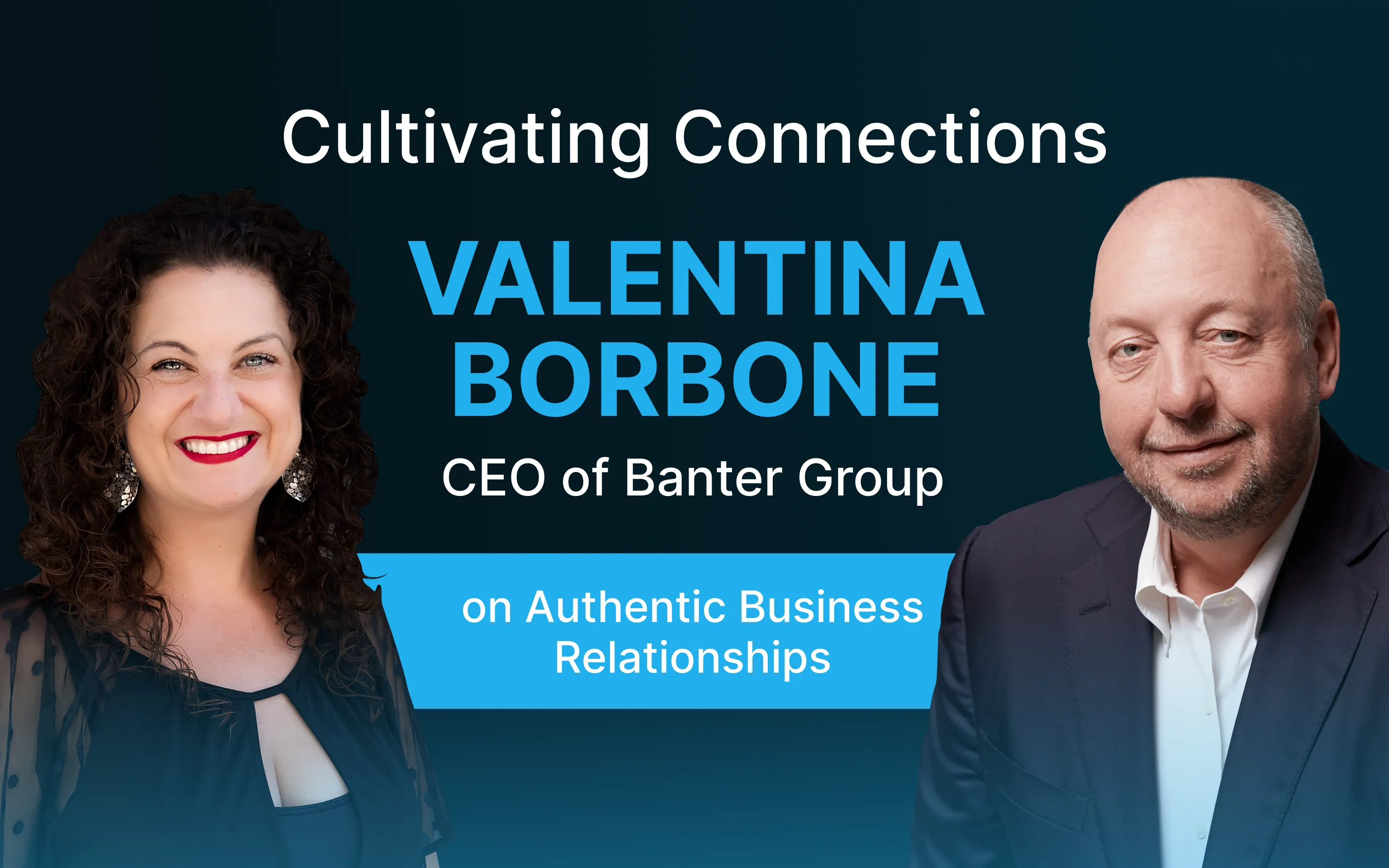
Jonathan Herps: Welcome back to Entrepreneurs Stories: Scaling Up — Episode 114. I'm delighted to be joined today by Valentina Bono — Val — Founder and Director of Banter Group, who happens to be based just 15 minutes from me here in regional New South Wales. Val, welcome.
Valentina Bono: Thank you — this is genuinely a joy for me.
Jonathan: Let's start at the beginning. Tell us about your entrepreneurial journey and what Banter Group is.
Val: It goes back to around 2009–2010. I was General Manager of a large, traditional creative media agency — pregnant, and fully aware that returning part-time in a senior client services role simply wasn't going to be an option. At 32, I felt professionally redundant. Having children has a way of forcing you to re-evaluate everything, and I took a leap of faith — spoke to my husband and launched a business with a partner at the time.
Over the next five years I learned an enormous amount, then left that business. We relocated to the Southern Highlands largely because my daughter was born with a rare genetic condition, which prompted another complete reassessment of priorities. I took two years off, fully intending never to run an agency again. But I kept seeing local businesses making costly marketing mistakes, and I couldn't help stepping in to offer guidance. Within two years of "not running a business," I had registered Banter Group. Eight months later I had eight employees. We're now six years old with a team of 15.
Banter Group is a full-service marketing agency — and I use that term deliberately, because many agencies claim it without delivering it. We cover everything: media buying, advertising, strategy, and the full marketing spectrum. If something is outside our genuine capability or scale, we'll say so and point clients in the right direction.
Jonathan: How would you approach a regional company of, say, 25 staff with no marketing function?
Val: One of our core engagements is acting as the outsourced CMO — the Chief Marketing Officer — for the business. We sit with the founders, understand their goals, and guide the entire marketing function. One of our core values is guide the way — which sometimes means working ourselves out of a job. I've told clients directly: you don't need this agency, you need an in-house hire. We can fill the gap in the interim and train whoever comes in. It really comes down to two things: budget, and what skill or time gaps we're actually filling.
Jonathan: If you were starting from scratch, what personal or leadership development would you prioritize?
Val: Work-life balance. That's my honest answer — and I say it having ignored it for years. If my 32-year-old self could hear one thing, it would be: prioritize your family. I have sacrificed an enormous amount of family time growing this business. I've missed school assemblies, awards nights, and moments I can't get back. I'm not abdicating parental responsibility — but I wasn't present in the way I wish I had been. Today I'm making different choices: I'm recording this from home so I can go straight into helping my son get ready for his Grade 6 formal this afternoon. That shift in priorities has been hard-won.
Jonathan: What qualities do you look for in employees and how do you build culture in a largely regional, collaborative team?
Val: I've always been drawn to younger talent who may not have university qualifications but demonstrate strong aptitude and hunger to grow. I didn't go to university myself, and I've always wanted to prove — and help others prove — that dedication and drive outperform credentials. Marketing is something I can teach. What I can't teach is the desire to learn, the willingness to be nurtured, and the courage to fail and own it. The admission of failure is genuinely hard to ask of people, but it's critical. I also don't micromanage — I look for self-starters I can trust with autonomy. And leadership for me isn't by the book; it's simply about being a good human.
Jonathan: What's been your biggest learning as a business owner?
Val: The most confronting learning of the past 12 months has been this: your employees are not your family. That's difficult to say, because I genuinely love and care for my team. But I had blurred that line completely. When team members left — for their own good reasons — I took it personally. I kept asking myself what I had failed to do, what I hadn't been good enough at. The truth is, I hadn't failed them. I had simply confused the professional relationship with a familial one.
It came to a head when I rang my counsellor — someone I hadn't spoken to in four years — in crisis. She listened and said: "The way you're reacting is as if they're family members, and they're not." And then she said something that completely reframed it: "All your life you've wanted a deep connection with your family. So you've recreated that in your business." That was a crushing and liberating moment simultaneously.
The second major learning was believing I could do it all myself. I'm highly disciplined and have a relentless work ethic — but working faster and longer never got me on top of it. The list just kept growing. Overwhelm is inevitable when you operate that way. You have to delegate, build systems, and find the right people for the roles you shouldn't be filling yourself.
Jonathan: What are the main challenges you're facing now?
Val: I thought I was scaling. I'd read the books — I know what needs to happen. But knowledge without action is wasted. I scaled from 15 to 21 staff in six months and everything imploded. Communication broke down — ironic for a communications business. We had too many channels: email, chat, text, voice messages, social DMs — every device beeping at once. I eventually just closed the laptop and walked away.
In the last 12 months I made the deliberate decision to scale back to 15. It's stable again. The turning point was appointing a strong General Manager — I didn't have that role filled until January of this year. Once I had a proper 2IC, we were able to divide and conquer. I also finally stopped trying to manage the financials myself. I hired an accountant and got off the tools in areas where I was never going to be excellent.
Jonathan: When you think of the word "successful," who comes to mind?
Val: Financial success alone isn't success to me. Success is the balance between purposeful achievement and a genuinely good life — and what that looks like is different for everyone. Someone I genuinely admire is Chelsea Pottenger from EQ Minds. She's a mental health and wellness coach, a speaker, and a mother — and she has found a way to pursue her purpose without trying to build a Behemoth. She prioritizes her family without apology. That, to me, is success.
I'd also note: the high-profile business names we admire are never doing it alone. They have entire teams behind them. I came from a belief that the only person you can rely on is yourself — and that belief has held me back.
Jonathan: Any books or resources you'd recommend?
Val: Useful Beliefs by Chris Helder — I buy it in bulk and give it to every new employee and anyone I meet who's struggling. It's a quick read that genuinely reframes how you think about limiting beliefs. It changed my life. I'd also strongly recommend therapy or counselling — not because something is broken, but because a great counsellor helps you see what's right in front of you with clarity you can't access alone.
Jonathan: Any final advice for entrepreneurs?
Val: Three things. First — get a coach or a trusted confidant, and get one early. Don't wait until you're struggling at 11 people. Get one when you're at four. Second — don't give up. It is genuinely tough out there right now across every industry. Third — think who before how. Stop trying to figure out how to do everything yourself. Find the right people who already know how. That one shift accelerates everything.
Jonathan: Val, it has been an absolute pleasure. Thank you so much.
Val: Thank you for making my hero dreams come true — truly. It's been wonderful.






.webp)
.webp)